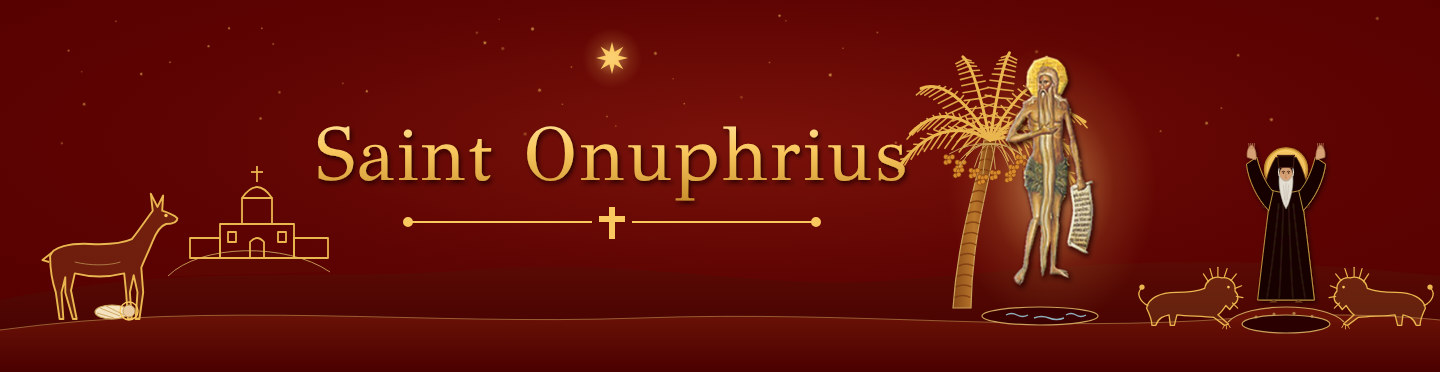
A Tribute to Saint Onuphrius
The Life, Ascesis and Hymnography of Saint Onuphrius the Egyptian
Contents

Translated from the Greek original. Biblical, patristic and liturgical passages are rendered directly from the Greek; the original text of each passage can be displayed beneath it.
Introduction
The Saints of the Church are not a few thousand; they number many millions. Any attempt to count them would, of course, be a rather vain labour. And if someone, hypothetically, wished to count all the Apostles, the Prophets, the Hierarchs, the Hieromartyrs, the Venerable Fathers, the Venerable Martyrs, the Confessors, and simply all the holy men and women together, he would find them to be more numerous than the sand of the sea.
Origins and Childhood
Saint Onuphrius the Egyptian is one of the greatest ascetic figures of the Egyptian deserts. According to his biographer, the venerable Paphnutius, Onuphrius came from Persia. That the homeland of Saint Onuphrius was Persia is mentioned neither in the Synaxaria in current use nor in the Canon of his feast.
According, then, to Saint Paphnutius, the father of Saint Onuphrius was a king of Persia. His mother was barren, and both of them besought God to grant them an heir. After many prayers God heard them, and when his mother conceived there was great joy in the palace. After the birth, his father saw a divine revelation urging him to name the child Onuphrius at holy baptism, and then to have him taken to a monastery in the Thebaid of Egypt.
So the Saint’s father did. As he made his way towards Egypt with his servants, a hind accompanied them by divine command and will, nourishing the newborn with her milk for as long as the whole journey lasted, to the wonder and astonishment of all. When they reached the monastery, the father of Saint Onuphrius related everything to the Abbot of the Monastery, who said: “No woman has ever come near this place. How is it possible for the child to be fed?” The Saint’s father replied: “Just as the Lord provided, and the hind that fed him accompanied us the whole way, so again, by divine command, she will come here every day to suckle him until he grows up.” And so the Abbot consented, and Onuphrius remained in that coenobium. His father departed for the palace, and the hind came every day until the third year and suckled him.
Our venerable father Onuphrius, having his origin in the land of Egypt, lived there a life of utmost love towards God and neighbour, of exemplary and moving humility, of stillness that purifies the passions, and of the cultivation of the virtues for the sake of communion with God and knowledge of himself, and of such non-possessiveness that, instead of garments to cover his body, he used his exceedingly long beard.
Endurance in Temptation
Through his life Saint Onuphrius put into practice what is set out in the second chapter of the Wisdom of Sirach. He remained attached to God and did not depart from Him, and afterwards became great and abundant in grace. He accepted every kind of temptation with great patience and joy, and he endured successive misfortunes steadfastly. Trials cleansed and sanctified him, as fire refines gold.
My son, if you come forward to serve the Lord God, prepare your soul for temptation. Set your heart aright and endure, and do not be hasty in the time of calamity. Cleave to Him and do not depart, that you may be increased at your latter end. Whatever is brought upon you, accept it, and be patient in the changes of your humiliation; for gold is tried in the fire, and acceptable men in the furnace of humiliation. Believe in Him, and He will help you; make your ways straight and hope in Him. You who fear the Lord, wait for His mercy, and do not turn aside, lest you fall. You who fear the Lord, believe Him, and your reward shall not fail. You who fear the Lord, hope for good things, for everlasting joy and mercy.1
Greek text
Τέκνον, εἰ προσέρχῃ δουλεύειν Κυρίῳ Θεῷ, ἑτοίμασον τὴν ψυχήν σου εἰς πειρασμόν· εὔθυνον τὴν καρδίαν σου καὶ καρτέρησον καὶ μὴ σπεύσῃς ἐν καιρῷ ἐπαγωγῆς· κολλήθητι αὐτῷ καὶ μὴ ἀποστῇς, ἵνα αὐξηθῇς ἐπ᾿ ἐσχάτων σου. Πᾶν ὃ ἐὰν ἐπαχθῇ σοι, δέξαι καὶ ἐν ἀλλάγμασι ταπεινώσεώς σου μακροθύμησον· ὅτι ἐν πυρὶ δοκιμάζεται χρυσὸς καὶ ἄνθρωποι δεκτοὶ ἐν καμίνῳ ταπεινώσεως. Πίστευσον αὐτῷ, καὶ ἀντιλήψεταί σου· εὔθυνον τὰς ὁδούς σου καὶ ἔλπισον ἐπ᾿ αὐτόν. Οἱ φοβούμενοι τὸν Κύριον ἀναμείνατε τὸ ἔλεος αὐτοῦ καὶ μὴ ἐκκλίνητε, ἵνα μὴ πέσητε. Οἱ φοβούμενοι Κύριον πιστεύσατε αὐτῷ, καὶ οὐ μὴ πταίσῃ ὁ μισθὸς ὑμῶν. Οἱ φοβούμενοι Κύριον ἐλπίσατε εἰς ἀγαθὰ καὶ εἰς εὐφροσύνην αἰῶνος καὶ ἐλέους.
Withdrawal into the Desert
Even as a child he showed a burning desire for total dedication to God. At a young age he joined a coenobitic brotherhood, where for many years he trained himself in spiritual and bodily self-control and in obedience. His great humility made his brethren love him dearly. When he had matured further in age, Onuphrius wished to go deeper into the desert, to come to know and imitate the life of the ascetics who dwelt there.
Later, with the blessing of his Elder, he withdrew into the desert. Having walked a long way into the desert, he came upon the hut of the hermit Hermias, who, through a divine revelation, was awaiting him. Hermias led him to a hut beneath an enormous palm tree, beside which murmured the waters of a clear spring. There Onuphrius gave himself to still greater spiritual struggle, and his fame spread among all the hermits, who often came to seek his counsel and receive his blessing. Through ascesis in grace he cleansed his soul of the passions and attained illumination and theosis. By his life Saint Onuphrius brings to mind the words of the book of the Wisdom of Sirach:
Look at the ancient generations and see: who ever trusted in the Lord and was put to shame? Or who abode in His fear and was forsaken? Or who called upon Him and was disregarded? For the Lord is compassionate and merciful; He forgives sins and saves in time of affliction. Woe to fearful hearts and slack hands, and to the sinner who walks upon two paths! Woe to the faint heart, for it does not believe; therefore it shall not be sheltered. Woe to you who have lost your endurance! What will you do when the Lord visits you? Those who fear the Lord will not disobey His words, and those who love Him will keep His ways. Those who fear the Lord will seek His good pleasure, and those who love Him will be filled with the law. Those who fear the Lord will prepare their hearts and humble their souls before Him. Let us fall into the hands of the Lord, and not into the hands of men; for as His majesty is, so also is His mercy.2
Greek text
Ἐμβλέψατε εἰς ἀρχαίας γενεὰς καὶ ἴδετε· τίς ἐνεπίστευσε Κυρίῳ καὶ κατῃσχύνθη; ἢ τίς ἐνέμεινε τῷ φόβῳ αὐτοῦ καὶ ἐγκατελείφθη; ἢ τίς ἐπεκαλέσατο αὐτόν, καὶ ὑπερεῖδεν αὐτόν; διότι οἰκτίρμων καὶ ἐλεήμων ὁ Κύριος καὶ ἀφίησιν ἁμαρτίας καὶ σώζει ἐν καιρῷ θλίψεως. Οὐαὶ καρδίαις δειλαῖς καὶ χερσὶ παρειμέναις καὶ ἁμαρτωλῷ ἐπιβαίνοντι ἐπὶ δύο τρίβους. Οὐαὶ καρδίᾳ παρειμένῃ, ὅτι οὐ πιστεύει· διὰ τοῦτο οὐ σκεπασθήσεται. Οὐαὶ ὑμῖν τοῖς ἀπολωλεκόσι τὴν ὑπομονήν· καὶ τί ποιήσετε ὅταν ἐπισκέπτηται ὁ Κύριος; Οἱ φοβούμενοι Κύριον οὐκ ἀπειθήσουσι ῥημάτων αὐτοῦ, καὶ οἱ ἀγαπῶντες αὐτὸν συντηρήσουσι τὰς ὁδοὺς αὐτοῦ. Οἱ φοβούμενοι Κύριον ζητήσουσιν εὐδοκίαν αὐτοῦ, καὶ οἱ ἀγαπῶντες αὐτὸν ἐμπλησθήσονται τοῦ νόμου. Οἱ φοβούμενοι Κύριον ἑτοιμάσουσι καρδίας αὐτῶν καὶ ἐνώπιον αὐτοῦ ταπεινώσουσι τὰς ψυχὰς αὐτῶν. Ἐμπεσούμεθα εἰς χεῖρας Κυρίου καὶ οὐκ εἰς χεῖρας ἀνθρώπων· ὡς γὰρ ἡ μεγαλωσύνη αὐτοῦ, οὕτως καὶ τὸ ἔλεος αὐτοῦ.
He teaches us not to turn away from the Lord when we fall into temptation, but to hope for the good things and the joy of eternity and for the mercy of the Lord.
Popular Devotion
The Saint fed on herbs, and his garment was made of palm leaves. In the villages of Crete Saint Onuphrius is known chiefly as Ai Roufnis. According to popular belief, Ai Roufnis (Saint Onuphrius) “sucks up” (roufa; a folk etymology) the ears of the new harvest of those who do not honour his memory. For this reason people neither reap nor thresh on the day of his feast. By the same folk etymology, Roufnis – roufo (“to suck” or “to inhale”), the tobacco sellers of Constantinople used to celebrate Saint Onuphrius as well. Saint Onuphrius is also especially honoured by barbers, because in his icons he is always depicted with an exceedingly long beard. Today the pious people of God regard him as the protector of judges and of those on trial, and more generally of Justice.
The Reward of the Righteous
The righteous live for ever, and their reward is in the hands of the Lord; the Most High cares for them. Therefore they shall receive from the hand of the Lord the glorious kingdom of Heaven and the beautiful royal diadem upon their heads, for the Lord will cover them with His right hand and with His arm will protect them against their enemies. The Lord will take His wrath as His weapons and will turn all the elements of nature into weapons to repel His enemies. He will put on His Justice as a garment and will wear impartial judgement as a helmet. Instead of an invulnerable shield He will put on holiness. He will use His stern wrath as a sharp sword. All the elements of nature will fight together with Him against these senseless ungodly men.
But the righteous live for ever; their reward is with the Lord, and the care of them is with the Most High. Therefore they shall receive the kingdom of glory and the diadem of beauty from the hand of the Lord, for with His right hand He will cover them and with His arm He will shield them. He will take His zeal as full armour, and will arm creation to repel His enemies; He will put on righteousness as a breastplate and wear impartial judgement as a helmet; He will take holiness as an invincible shield and sharpen stern wrath for a sword, and the world will join with Him in battle against the senseless. Well-aimed shafts of lightning will fly, and from the clouds, as from a well-drawn bow, they will leap to the mark; and hailstones full of wrath will be hurled as from a catapult. The water of the sea will rage against them, and rivers will overwhelm them relentlessly. A mighty wind will rise against them, and like a tempest it will winnow them away. Lawlessness will lay waste the whole earth, and evil-doing will overturn the thrones of rulers.3
Greek text
Δίκαιοι δὲ εἰς τὸν αἰῶνα ζῶσι, καὶ ἐν Κυρίῳ ὁ μισθὸς αὐτῶν, καὶ ἡ φροντὶς αὐτῶν παρὰ Ὑψίστῳ. Διὰ τοῦτο λήψονται τὸ βασίλειον τῆς εὐπρεπείας καὶ τὸ διάδημα τοῦ κάλλους ἐκ χειρὸς Κυρίου, ὅτι τῇ δεξιᾷ σκεπάσει αὐτοὺς καὶ τῷ βραχίονι ὑπερασπιεῖ αὐτῶν. Λήψεται πανοπλίαν τὸν ζῆλον αὐτοῦ καὶ ὁπλοποιήσει τὴν κτίσιν εἰς ἄμυναν ἐχθρῶν· ἐνδύσεται θώρακα δικαιοσύνην καὶ περιθήσεται κόρυθα κρίσιν ἀνυπόκριτον· λήψεται ἀσπίδα ἀκαταμάχητον ὁσιότητα, ὀξυνεῖ δὲ ἀπότομον ὀργὴν εἰς ῥομφαίαν, συνεκπολεμήσει δὲ αὐτῷ ὁ κόσμος ἐπὶ τοὺς παράφρονας. Πορεύσονται εὔστοχοι βολίδες ἀστραπῶν καὶ ὡς ἀπὸ εὐκύκλου τόξου τῶν νεφῶν ἐπὶ σκοπὸν ἁλοῦνται, καὶ ἐκ πετροβόλου θυμοῦ πλήρεις ῥιφήσονται χάλαζαι. Ἀγανακτήσει κατ᾿ αὐτῶν ὕδωρ θαλάσσης, ποταμοὶ δὲ συγκλύσουσιν ἀποτόμως. Ἀντιστήσεται αὐτοῖς πνεῦμα δυνάμεως καὶ ὡς λαῖλαψ ἐκλικμήσει αὐτούς. Καὶ ἐρημώσει πᾶσαν τὴν γῆν ἀνομία, καὶ ἡ κακοπραγία περιτρέψει θρόνους δυναστῶν.
Egyptian Monasticism
One is he who bound the tyrant through struggles; another, he who bound him through humility; and another, he who bound him through the intervention and manifestation of God. The first resembles the morning star, the second the full moon, and the third the all-radiant sun. Yet all three have their citizenship in heaven. From the dawn light is born, and from the light the sun comes forth.
During the first three centuries of the Church, well before the cessation of the persecutions under Constantine the Great, there appeared devout Christians who fled the world in order to devote themselves to ascesis and prayer, undistracted by the cares of life and the noise of the world. Others withdrew into the desert in order to seek there not merely safety from the dangers of a corrupt civilisation, but that complete offering of their life to God. Thus we have the development of early eremitic monasticism.
In the fourth century, however, Christianity enters a new period of its historical course. Persecution ceases, the Constantinian peace prevails, the Church is now honoured and protected by the state, and acquires wealth and privileges. This results in its evident secularisation. It is precisely then that the example of the few isolated anchorites of the first three centuries finds myriads of imitators. Sketes, Lavras and coenobia, great and very numerous, are founded. Monasticism now flourishes; the holy fathers of the desert shine in the firmament of the Church because “the hand of the Lord was with them”,4 and it spreads from Egypt and Libya to Sinai, Palestine, Syria, Mount Olympus in Bithynia, the Holy Mountain, and the whole of the then known world.
At the beginning of his monastic life Saint Onuphrius enters a coenobium near Hermopolis in the Thebaid. The coenobitic system is a stricter form of the lavriotic and was shaped by Saint Pachomius the Great in the fourth century in Egypt. More precisely, before departing for the desert, Saint Onuphrius lived in a large lavra of monks called Smaoun, in Upper Egypt, on the borders of Oxyrhynchus. There one hundred and fifty monks lived, keeping monastic order and purity. There Abba Onuphrius learned the monastic way, beside other godly elders who had reached perfection and lived like the angels of God. There he heard of the quiet and solitary life of two great figures of our Church: the ascetic and eremitic life of the Prophet Elijah the Tishbite, and of his imitator John the Forerunner, who prepared the coming of Christ and who, like Elijah, wearing an ascetic garment and following the eremitic life, preached to the people the baptism of repentance.
Stillness, Watchfulness and Divine Grace
The uncreated Grace of God flooded his whole being, his soul and his body, and for this reason his remains were fragrant after his holy repose. “Whoever has the Grace of the Holy Spirit in both soul and body possesses perfect love. And if one preserves this grace, his relics will be sanctified, like those of the holy martyrs, the prophets or the other great saints.”5 In the Orthodox East the monastic life, as a means of salvation in Christ, was from the beginning bound up with stillness (hesychia), which is a form of contemplative ascesis aimed at watchfulness (nepsis). The final stage of watchfulness is the truth in Christ: complete and perfect mastery over the passions and the submission of the whole human being to the will of God.
The all-good God brought man into this present life not so that his soul might cling to possessions and money, to honours and pleasures, and in general to all the goods of this vain world. Man was not created only for this transient life.
For all these reasons the Lord counsels us:
But take heed to yourselves, lest your hearts be weighed down with dissipation and drunkenness and the cares of this life, and that day come upon you unexpectedly; for as a snare it will come upon all who dwell on the face of the whole earth. Watch therefore at all times, praying that you may be counted worthy to escape all these things that will come to pass, and to stand before the Son of Man.6
Greek text
Προσέχετε δὲ ἑαυτοῖς μήποτε βαρηθῶσιν ὑμῶν αἱ καρδίαι ἐν κραιπάλῃ καὶ μέθῃ καὶ μερίμναις βιωτικαῖς, καὶ αἰφνίδιος ἐφ᾿ ὑμᾶς ἐπιστῇ ἡ ἡμέρα ἐκείνη· ὡς παγὶς γὰρ ἐπελεύσεται ἐπὶ πάντας τοὺς καθημένους ἐπὶ πρόσωπον πάσης τῆς γῆς. Ἀγρυπνεῖτε οὖν ἐν παντὶ καιρῷ δεόμενοι ἵνα καταξιωθῆτε ἐκφυγεῖν πάντα τὰ μέλλοντα γίνεσθαι καὶ σταθῆναι ἔμπροσθεν τοῦ υἱοῦ τοῦ ἀνθρώπου.
Saint Onuphrius, enraptured by the eremitic life and by withdrawal from the world, put to death his members which are upon the earth,7 and, enduring the frost of the night and the burning heat of the day, attained the heavenly life, beholding, as his hymnographer emphasises, the ineffable beauty of his Creator. He lived in the desert for about sixty years, having self-control as his food and poverty and non-possessiveness as his wealth. Saint Onuphrius had as his garment, according to the exhortation of the Apostle Paul, Jesus Christ.8 Dispassion should not be confused with the absence of temptations, but on the contrary with their strong presence and with complete freedom in facing them.
Yet the heart of man, too, becomes a desert when it loses divine Grace. Those who have tasted the sweetness of divine Grace, even a little, and then happened to lose it, seek it as a mother seeks her little child whom she has lost in a crowd: she calls and runs and searches for it with tears and pain. And when she finds it, she rejoices and exults and holds it tightly in her arms, taking care not to lose it again. Something similar happens to the one who has tasted divine Grace and for some reason has lost it. He feels his heart desolate and empty, and he cries out, and calls, and prays unceasingly. And when, after great struggle, anguish, searching, pain and weeping, he finds it again, then he rejoices and exults and cries out with the Prophet Isaiah: “Rejoice, O thirsty desert…”.9
Union with God is a mystery accomplished in human persons. A perfect person makes all of his decisions in full awareness. He is free from all compulsion, from every natural necessity. The further one advances on the way of union, the more conscious one becomes. This awareness is called, in the spiritual life, knowledge (gnosis) by the ascetic Fathers of the East.
The Meeting with Abba Paphnutius
Once Abba Paphnutius visited the venerable Onuphrius. The two ascetics rejoiced in each other’s presence, shared their experiences and were spiritually strengthened. God, however, so arranged matters that this meeting coincided with the hour of the “departure” of the venerable Onuphrius; and thus his body was buried by Abba Paphnutius beneath the great palm tree, while his soul “rejoices in heaven together with all the saints”. Thus he reminded all of the words of the Apostle Paul: “exercise yourself unto godliness”;10 that is, train and accustom yourself to the continual practice of the holy life.
Saint Silouan the Athonite, when he speaks of the lament of Adam after the disobedience and the loss of Paradise, is in essence describing his own lament, when he lost the Grace of God and for many years sought it with pain and tears. And he teaches, from his own experience, that the surest way to find and preserve divine Grace is the way of humility.
The Desert as a Spiritual Font
The desert became the spiritual font in which the ascetics were raised to unattainable heights of spiritual ascent. The dazzling light of the Godhead leads man to spiritual serenity, calm and blessedness. The ascetic struggle is in essence the passage along the “narrow and afflicted way”,11 which nevertheless sweetens existence and gives it meaning. It also supplies the spiritual organism with strong defences, so that it can withstand hardship, drive away the bitterness of sorrows and experience sweet joyful mourning (charmolypi). Yet the desert, too, has its storms and tempests; the steep mountains have strong winds, winds that whirl body and spirit.
Saint Onuphrius fainted very many times in the desert; he was often exhausted by hunger, thirst, the cold of the night and the scorching sun of the day. His body was baked under the sun of heaven. When God saw that he had suffered enough from this warfare, He sent His angel to care for his food, and every day the angel brought him something to sustain his body. In that place in the desert where Abba Onuphrius lived in ascesis there was a date palm which bore twelve clusters of dates a year; one great cluster of dates fell to the Saint each month. There were also some herbs and other small shrubs whose leaves had a wonderful taste in his mouth, resembling that of honey.
When one does the will of the Lord, He will provide, wherever on earth we may be. Indeed it is written in the Holy Scriptures that “He might make you know that man shall not live by bread alone, but by every word that proceeds out of the mouth of God shall man live”.12 And elsewhere the holy Gospels write:
Therefore do not be anxious, saying, ‘What shall we eat?’ or ‘What shall we drink?’ or ‘What shall we wear?’ For the Gentiles seek after all these things; and your heavenly Father knows that you need them all. But seek first the kingdom of God and His righteousness, and all these things shall be added to you.13
Greek text
Μὴ οὖν μεριμνήσητε λέγοντες, τί φάγωμεν ἢ τί πίωμεν ἢ τί περιβαλώμεθα; πάντα γὰρ ταῦτα τὰ ἔθνη ἐπιζητεῖ· οἶδε γὰρ ὁ πατὴρ ὑμῶν ὁ οὐράνιος ὅτι χρῄζετε τούτων ἁπάντων. Ζητεῖτε δὲ πρῶτον τὴν βασιλείαν τοῦ Θεοῦ καὶ τὴν δικαιοσύνην αὐτοῦ, καὶ ταῦτα πάντα προστεθήσεται ὑμῖν.
The Prayer of Monks
Saint Silouan the Athonite writes: “The world thinks that monks are a useless race. But they are wrong to think so. They do not know that the monk prays for the whole world. They do not see his prayers and do not know with what compassion the Lord receives them. Monks wage a great war against the passions, and for this struggle of theirs they will be great before God.”5
Saint Onuphrius had as the food of his soul and the illumination of his mind the mother of the virtues, blessed prayer, as Saint John of the Ladder says, according to whom: “Prayer, in its quality, is the converse and union of man with God; in its action, … reconciliation with God, propitiation for sins, food of the soul, enlightenment of the mind, a mirror of progress.”14
The greatest offering of monks, and the greatest expression of their love for the whole world, is their prayer, as Saint Silouan says: “The monk is an intercessor for the whole world; he weeps for the whole world, and in this lies his principal work. Who, then, moves him to shed tears for the whole world? Our Lord Jesus Christ, the Son of God. He gives the monk the love of the Holy Spirit, and because of this love the heart of the monk is always sorrowful, because not all people are being saved.”5
In the first period after one withdraws into the desert, one suffers from hunger, thirst, and the warfare which the sleepless enemy stirs up against the anchorites; for the devil sends them temptations and fights against them, knowing well how great an honour and glory these anchorites find with God when they leave their body. When, then, they endure all this with patience, the help of God makes them strong. God then gives angels to bring them food, and so they live in peace and spiritual rest. “But those who wait upon God shall renew their strength; they shall mount up with wings like eagles; they shall run and not be weary; they shall walk and not hunger.”15 The Lord will never despise the humble, and afflictions do not bring the poor to their knees for ever. God repays each one according to his works and the afflictions he has endured. Blessed is he who works according to the will of God on this earth; the angels will serve him and protect him for as long as he is on earth in the body.
When the Lord sent His Disciples to preach the Gospel to men, He said:
You are the salt of the earth; but if the salt has lost its savour, with what shall it be salted? It is then good for nothing but to be thrown out and trodden under foot by men. You are the light of the world. A city set on a hill cannot be hidden. Nor do men light a lamp and put it under a bushel, but on a lampstand, and it gives light to all in the house. Let your light so shine before men, that they may see your good works and glorify your Father who is in heaven.16
Greek text
Ὑμεῖς ἐστε τὸ ἅλας τῆς γῆς· ἐὰν δὲ τὸ ἅλας μωρανθῇ, ἐν τίνι ἁλισθήσεται; εἰς οὐδὲν ἰσχύει ἔτι εἰ μὴ βληθῆναι ἔξω καὶ καταπατεῖσθαι ὑπὸ τῶν ἀνθρώπων. Ὑμεῖς ἐστε τὸ φῶς τοῦ κόσμου. Οὐ δύναται πόλις κρυβῆναι ἐπάνω ὄρους κειμένη· οὐδὲ καίουσι λύχνον καὶ τιθέασιν αὐτὸν ὑπὸ τὸν μόδιον, ἀλλ᾿ ἐπὶ τὴν λυχνίαν, καὶ λάμπει πᾶσι τοῖς ἐν τῇ οἰκίᾳ. Οὕτω λαμψάτω τὸ φῶς ὑμῶν ἔμπροσθεν τῶν ἀνθρώπων, ὅπως ἴδωσιν ὑμῶν τὰ καλὰ ἔργα καὶ δοξάσωσι τὸν πατέρα ὑμῶν τὸν ἐν τοῖς οὐρανοῖς.
It should be noted that the monk, illumined by the divine Light of the grace of God, never ceases to pray with boundless love for those who live in the world.
The Final Prayer and Repose of the Saint
Before his end, and in the presence of Paphnutius, the venerable Onuphrius said the following prayer:
Most High and invisible God, whose power is unsearchable and whose glory is incomprehensible and ineffable, and whose mercy is infinite and immeasurable: I hymn, bless, worship and glorify You, whom I have longed for from my youth and whom I have followed. Hear me, for to You have I cried; for You have looked upon my humility, You have saved my soul from its distresses, You have not shut me up in the hands of enemies, but have set my feet in a broad place. I beseech You, my Lord: shelter me with Your right hand, that my soul may not be troubled by the demons when it departs from the body; but receive it through Your holy Angels and set it where the light of Your countenance shines; for blessed are You and glorified unto the ages. Remember, O all-compassionate and most merciful One, Your faithful people. And whoever finds himself in danger at sea, or under the wrath of a judge, or in any other distress, and calls upon You, saying: “Almighty Lord, through the intercessions of Your servant Onuphrius, have mercy on me” — I entreat Your kingship, as You have promised me, hear his supplication. Lord, into Your hands I commit my spirit.
Greek text
Ὕψιστε Θεὲ καὶ ἀόρατε, οὗ ἡ δύναμις ἀνεξιχνίαστος καὶ ἡ δόξα ἀκατανόητος καὶ ἀνέκφραστος, καὶ τὸ ἔλεος ἄπειρον καὶ ἀμέτρητον, ὑμνῶ, εὐλογῶ, προσκυνῶ καὶ δοξάζω Σε, ὃν ἐπόθησα ἐκ νεότητός μου καὶ Σοὶ ἠκολούθησα. Ἐπάκουσόν μου, πρὸς Σὲ γὰρ ἐκέκραξα, ὅτι ἐπεῖδες τὴν ταπείνωσίν μου, ἔσωσας ἐκ τῶν ἀναγκῶν τὴν ψυχήν μου, οὐ συνέκλεισάς με εἰς χεῖρας ἐχθρῶν, ἀλλ᾽ ἔστησας ἐν εὐρυχώρῳ τοὺς πόδας μου. Δέομαί Σου, Κύριέ μου· τῇ Σῇ δεξιᾷ σκέπασόν με, ἵνα μὴ ταραχθῇ ἡ ψυχή μου ἀπὸ τοὺς δαίμονας, ὅταν ἐξέρχεται ἐκ τοῦ σώματος, ἀλλὰ παράλαβε αὐτὴν διὰ ἁγίων Ἀγγέλων Σου καὶ κατάταξον αὐτὴν ἔνθα ἐπισκοπεῖ τὸ φῶς τοῦ προσώπου Σου, ὅτι εὐλογητὸς εἶ καὶ δεδοξασμένος εἰς τοὺς αἰῶνας. Μνήσθητι, Πανοικτίρμον καὶ Πολυέλεε, τοῦ πιστοῦ λαοῦ Σου. Καὶ ὅστις εὑρεθῇ εἰς κίνδυνον θαλάσσης ἢ εἰς θυμὸν δικαστοῦ ἢ εἰς ἄλλην τινὰ στενοχωρίαν, καὶ Σὲ ἐπικαλεσθῇ λέγων· Παντοδύναμε Κύριε, διὰ πρεσβειῶν τοῦ δούλου Σου Ὀνουφρίου ἐλέησόν με, παρακαλῶ τὴν βασιλείαν Σου, καθὼς μοῦ ἔταξες, ἐπάκουσον τῆς δεήσεως αὐτοῦ. Κύριε, εἰς χεῖράς Σου παρατίθημι τὸ πνεῦμά μου.
Then he made a deep prostration, down to the ground, and there “he finished his course”.17 With glory and honour he gave up his spirit into the hands of God. Then a multitude of angels was heard above the remains of Saint Onuphrius, singing hymns in honour of Abba Onuphrius, and great indeed was the joy in Heaven at the entry of the Saint into the Kingdom of our Lord Jesus Christ.
The biographer of Saint Onuphrius, the venerable Paphnutius, relates that two lions opened the grave in which the Saint’s holy remains were buried. Saint Paphnutius buried Saint Onuphrius after his death, having torn his own poor garment in two: with one half he wrapped the naked body of the venerable Father, covered with white hair, and he kept the other half to cover his own body. Thus, without a tunic, Saint Onuphrius departed for the other life, not merely keeping but surpassing the Lord’s commandment “He who has two tunics, let him share with him who has none; and he who has food, let him do likewise”,18 since he was found naked at the end of his life. The epigrammatic encomiastic distich of the Synaxarion says:19
you surpassed, going naked to the end.
On the twelfth, Onuphrius was taken from this life without a tunic.
Greek text
Καὶ τὴν ἑνὸς χιτῶνος ἐντολήν, Πάτερ,
Ὑπερβέβηκας, γυμνητεύσας εἰς τέλος.
Δωδεκάτῃ ἀχίτωνα Ὀνούφριον ἐκ βίου ἦραν.
The Saint as a Model
Saint Onuphrius teaches and inspires us through his holy life. The life of Saint Onuphrius teaches us and calls us “to make their good our own through imitation”:20 to imitate him, so as to make his virtue our own. The Saint also helps us with his intercessions. He is a work of art of the Holy Spirit, a most beautiful image of God, a living and animate temple of His, a treasure and an ornament of our Church. He teaches us that life in Christ is not simply communion with Christ, life in His Presence. It is something far greater and incomparably higher: it is union with Christ.
He makes known to us that this transient earthly life of ours, which we tremble lest we lose and which we protect like the small flame at the tip of a candle flickering as the wind blows upon it, this small life can be not only preserved but made to shine “as the sun” in no other way than by extinguishing it ourselves. “He who finds his life will lose it, and he who loses his life for my sake will find it.”21 Whoever wishes to save his life will lose the blessed spiritual life. But whoever does not live for himself, but offers his life to Christ and to obedience to His commandments, will gain it eternal, immortal and true in His Kingdom.
He who receives you receives me, and he who receives me receives Him who sent me. He who receives a prophet in the name of a prophet shall receive a prophet’s reward, and he who receives a righteous man in the name of a righteous man shall receive a righteous man’s reward. And whoever gives one of these little ones even a cup of cold water to drink in the name of a disciple, truly I say to you, he shall by no means lose his reward.22
Greek text
Ὁ δεχόμενος ὑμᾶς ἐμὲ δέχεται, καὶ ὁ ἐμὲ δεχόμενος δέχεται τὸν ἀποστείλαντά με. Ὁ δεχόμενος προφήτην εἰς ὄνομα προφήτου μισθὸν προφήτου λήψεται, καὶ ὁ δεχόμενος δίκαιον εἰς ὄνομα δικαίου μισθὸν δικαίου λήψεται. Καὶ ὃς ἐὰν ποτίσῃ ἕνα τῶν μικρῶν τούτων ποτήριον ψυχροῦ μόνον εἰς ὄνομα μαθητοῦ, ἀμὴν λέγω ὑμῖν, οὐ μὴ ἀπολέσῃ τὸν μισθὸν αὐτοῦ.
Greek text
Βλάστημα Βασιλέων εὐθαλὲς τῆς Περσίας, Ὀνούφριε, βουλῇ οὐρανίῳ σὲ ὡδήγησεν ὁ σὸς πατὴρ εἰς μονὴν Αἰγύπτου ἀσκητῶν πάνσεπτον, ὡς βρέφος ἀρτιγέννητον Κυρίῳ ἀσιγήτως ψάλλον.
The Jesus Prayer
The Prayer “Lord Jesus Christ, have mercy on me” is the cream of all prayers and is summed up in only five words, steadily repeated.23 The invocation “Lord” expresses a grateful disposition of the soul and trust in the gifts that flow from the redeeming Sacrifice of the Son of God. The invocation “Jesus” expresses the passion and the fire of the soul towards the Beloved. The invocation “Christ” rests upon a relationship of repentance and forgiveness, like that of a wounded man towards the one who heals him. Finally, the invocation “have mercy on me” conveys the drama of the one who suffers. Here there is an awareness of the weight of sins, but also a taste of the goodness of God and of His forgiveness, since this invocation partakes of boldness (parrhesia) more than the invocation “forgive”.
The Souls of the Righteous
But the souls of the righteous are in the hand of God, and no torment shall touch them. In the eyes of the foolish they seemed to have died, and their departure was thought to be an affliction, and their going from us to be their destruction; but they are at peace. For though in the sight of men they were punished, their hope is full of immortality. Having been disciplined a little, they will receive great good, because God tested them and found them worthy of Himself; like gold in the furnace He tried them, and like a whole burnt offering He accepted them. In the time of their visitation they will shine forth, and will run like sparks through the stubble. They will judge nations and rule over peoples, and the Lord will reign over them for ever. Those who trust in Him will understand truth, and the faithful will abide with Him in love, because grace and mercy are upon His holy ones, and He watches over His elect.24
Greek text
Δικαίων δὲ ψυχαὶ ἐν χειρὶ Θεοῦ, καὶ οὐ μὴ ἅψηται αὐτῶν βάσανος. Ἔδοξαν ἐν ὀφθαλμοῖς ἀφρόνων τεθνάναι, καὶ ἐλογίσθη κάκωσις ἡ ἔξοδος αὐτῶν καὶ ἡ ἀφ᾿ ἡμῶν πορεία σύντριμμα, οἱ δέ εἰσιν ἐν εἰρήνῃ. Καὶ γὰρ ἐν ὄψει ἀνθρώπων ἐὰν κολασθῶσιν, ἡ ἐλπὶς αὐτῶν ἀθανασίας πλήρης· καὶ ὀλίγα παιδευθέντες μεγάλα εὐεργετηθήσονται, ὅτι ὁ Θεὸς ἐπείρασεν αὐτοὺς καὶ εὗρεν αὐτοὺς ἀξίους ἑαυτοῦ· ὡς χρυσὸν ἐν χωνευτηρίῳ ἐδοκίμασεν αὐτοὺς καὶ ὡς ὁλοκάρπωμα θυσίας προσεδέξατο αὐτούς. Καὶ ἐν καιρῷ ἐπισκοπῆς αὐτῶν ἀναλάμψουσι καὶ ὡς σπινθῆρες ἐν καλάμῃ διαδραμοῦνται· κρινοῦσιν ἔθνη καὶ κρατήσουσι λαῶν, καὶ βασιλεύσει αὐτῶν Κύριος εἰς τοὺς αἰῶνας. Οἱ πεποιθότες ἐπ᾿ αὐτῷ συνήσουσιν ἀλήθειαν, καὶ οἱ πιστοὶ ἐν ἀγάπῃ προσμενοῦσιν αὐτῷ, ὅτι χάρις καὶ ἔλεος ἐν τοῖς ὁσίοις αὐτοῦ, καὶ ἐπισκοπὴ ἐν τοῖς ἐκλεκτοῖς αὐτοῦ.
The life of the righteous is under the protecting hand of God, and no affliction will touch them without His permission. In the eyes of the foolish ungodly, their death was regarded as annihilation, and their untimely departure from this present life as punishment and the frustration of their hopes. Their departure from life was regarded as utter destruction. Yet they are in peace. Even if in the eyes of men they appear to suffer, they have a firm conviction that they will enter into immortality. If they suffer a few torments here, they will receive a great reward there, because the Lord tested them through afflictions and found them worthy of His reward. The Lord tested them as the goldsmith tests gold by fire in his refining crucible, and He received them favourably like the whole burnt offerings of sacrifices. They will shine when the Lord visits them, and like sparks they will run through, burning the dry stubble, the ungodly. They will condemn the ungodly nations and rule over the ungodly peoples, for the Lord will be their King unto the ages. Those who have faith and trust in God will understand the truth of His words and promises, and with love they will endure and remain near Him, for His gift and compassion will be given to those devoted to Him, and His care will turn towards His elect.
Our Fathers teach that the Spirit is a gift, and that the request for this gift is the only one that never remains without an immediate answer. The invocation touches the very nature of the One who is given and moves Him to reveal Himself. When man seeks the Kingdom of Heaven, he obeys his Lord and God and becomes His child. And when he finds it, he rejoices like one who has found a pearl of great price, a hidden treasure, and his joy is fulfilled. So too Saint Onuphrius was shown to be a radiant star to those who live the monastic life, and he shines over the whole inhabited world like the moon in the night, and in this way he shines in ascetic struggles like the sun. Therefore let us ask the Saint not to cease interceding unceasingly for us all, as the corresponding kontakion of the Saint in the Great Horologion says:25
Greek text
Αστήρ φαεινός εδείχθης τοις μονάζουσιν, ως φέγγος νυκτί αυγάζεις εν τοις πέρασιν· ούτω, πάτερ, έλαμψας εν ασκήσει καθάπερ ήλιος· διά τούτο, Ονούφριε, μη παύση πρεσβεύων υπέρ πάντων ημών.
The Day of Judgement
Then the righteous man will stand with great boldness before the face of those who have afflicted him and made light of his labours. When they see him, they will be shaken with dreadful fear, and will be amazed at the unexpectedness of his salvation.26
Greek text
Τότε στήσεται ἐν παρρησίᾳ πολλῇ ὁ δίκαιος κατὰ πρόσωπον τῶν θλιψάντων αὐτὸν καὶ τῶν ἀθετούντων τοὺς πόνους αὐτοῦ. Ἰδόντες ταραχθήσονται φόβῳ δεινῷ καὶ ἐκστήσονται ἐπὶ τῷ παραδόξῳ τῆς σωτηρίας.
On the day of Judgement the righteous man will stand upright with great boldness before those who persecuted him on earth and rejected his labours. When they see him, they will be troubled and greatly afraid; they will be astonished at his unexpected salvation.
They will speak among themselves in repentance, and in anguish of spirit they will groan and say: “This is the man whom we once held in derision and made a byword of reproach — we fools! We accounted his life madness and his end without honour. How has he been numbered among the sons of God, and why is his lot among the saints? So it was we who strayed from the way of truth; the light of righteousness did not shine on us, and the sun did not rise upon us.”27
Greek text
Ἐροῦσιν ἐν ἑαυτοῖς μετανοοῦντες καὶ διὰ στενοχωρίαν πνεύματος στενάξονται καὶ ἐροῦσιν· οὗτος ἦν ὃν ἔσχομέν ποτε εἰς γέλωτα καὶ εἰς παραβολὴν ὀνειδισμοῦ οἱ ἄφρονες· τὸν βίον αὐτοῦ ἐλογισάμεθα μανίαν καὶ τὴν τελευτὴν αὐτοῦ ἄτιμον. Πῶς κατελογίσθη ἐν υἱοῖς Θεοῦ καὶ ἐν ἁγίοις ὁ κλῆρος αὐτοῦ ἐστιν; ἄρα ἐπλανήθημεν ἀπὸ ὁδοῦ ἀληθείας, καὶ τὸ τῆς δικαιοσύνης φῶς οὐκ ἔλαμψεν ἡμῖν, καὶ ὁ ἥλιος οὐκ ἀνέτειλεν ἡμῖν.
And they will say among themselves, in repentance and in great anguish of soul, groaning: Is this the one whom we fools once derided and held as a byword of mockery? We thought his life unbalanced and his untimely death dishonourable. How then has he been numbered among the sons of God, and how is his place among the holy men? So we strayed from the true way, and the light of righteousness did not shine upon us; the sun of truth did not rise for us.
The righteous, on the contrary, like Saint Onuphrius, taste the rich blessings and gifts of God throughout the day and, reaching the end of the day’s labour, glorify God in Trinity: a doxology springing from man towards God the Creator and Father for the passing of the day. And this doxology is not a momentary state of man. It is not a thanksgiving tied to a particular time, but extends to the whole doxological dimension of human life. Divine Grace illumines, strengthens and empowers the natural faculties of man on the path of salvation and return to God; in other words, regeneration, justification and sanctification.
The Iconography of the Saint
Saint Onuphrius is depicted in iconography as a naked old man with long hair, his beard reaching down to his feet, and his scroll says:
nor the mire of the passions delight you;
else you will weep in the all-devouring flame.
Greek text
Μη κόρος εντέρων σε Χριστού χωρίση,
μη βόρβορος σε των παθών καθηδύνη·
ει δ’ ουν, δακρύσεις εν φλογί τη παμφάγω.
The state of man’s glory in Christ Jesus, proceeding from his communion with the divine glory, entails a real transformation of the whole human being into a new creation.
Theosis
Theosis, that is, the union of man with God by grace, was the ultimate purpose of man’s creation. Sin temporarily frustrated this purpose. But because none of God’s saving counsels can be revoked, the Word personally undertook, through His Incarnation, to bring to completion the interrupted work of man’s theosis. Theosis took place in His divine-human person, on the basis of the exchange of properties (communicatio idiomatum) of the two natures. Human nature was filled with God not outwardly and superficially, but deeply and inwardly, without, of course, being changed into divinity: just as iron, when it comes into contact with fire, becomes red-hot without losing its natural property. This theosis extends to all the faithful as well, after purification from sin and the working-out of God’s commandments.
We observe that, as with other people of God, when someone is renewed in Christ, creation too, which groans and travails together with fallen man, is tamed. Irrational nature returns to its paradisal state and places itself at the service of man.
As is attested in his kontakion, Saint Onuphrius received into his heart the noetic and heavenly light, and proved to be a vessel of the incorruptible Trinitarian Godhead; and now he has been numbered with the Angels and sings aloud the doxological hymn “Alleluia”.
The Commemoration of the Saint
Saint Onuphrius became a companion of the angels, or rather an earthly angel, because he emulated the way of life of the great anchorite Saints of the Church, John the Forerunner and Elijah the Tishbite, thus becoming their imitator.
Saint Onuphrius ended his earthly life on 12 June, the day on which our Orthodox Church honours and celebrates his memory, together with that of our venerable father Peter of Athos. The memory of the venerable Onuphrius the Egyptian falls, according to the Old (Julian) calendar (followed by the Patriarchate of Jerusalem, the Holy Mountain, the Russian Church and others), between the Saturday of Souls and the Friday of the fifth week of Matthew; and according to the New calendar (followed by the Church of Greece, the Ecumenical Patriarchate and others), between the Sunday of the Blind Man and the Saturday of the third week of Matthew.
From the Hymnography of the Saint
Greek text
Ὁδήγησον πρὸς θελημάτων ἐκπλήρωσιν τοῦ Ὑψίστου τοὺς προστρέχοντας εὐλαβῶς τῇ θείᾳ σου χάριτι, Ὀνούφριε, ἄγγελε τῆς ἐρήμου.
Greek text
Ζόφωσιν συναφείας χοϊκῆς ἀποῤῥίψας, Ὀνούφριε, καὶ τοῦ πονηροῦ πειρασμούς, Ἀγγέλων φωταυγῶν πέφηνας συνόμιλος· διόπερ σε γεραίροντες τρανῶς βοῶμεν·
Greek text
Ὀνούφριε, ὅσιε ἀσκητά, ὁ ἐν τῇ ἐρήμῳ ὑπομείνας τὸν παγετὸν νυκτὸς καὶ τὸν καύσωνα ἡμέρας διὰ Χριστόν, ἴθυνόν με πρὸς θέωσιν.
Greek text
Ὅσιε Ὀνούφριε, τῆς στεῤῥοτάτης ἀσκήσεως, ἐν τῇ καυστικῇ καὶ ἐπιπόνῳ διατριβῇ, ὡς ἐν ἀδύτοις ἀναπαυόμενος διετέλεσας· τοῖς ἐρημικωτέροις γὰρ ἑαυτὸν συνάψας πνευματικῶς, τὰς πυριφλέκτους φαρέτρας τῶν δαιμόνων κατεπάτησας, καὶ ὑπεράνω πάσης ἀρετῆς γεγονώς, συναυλίζῃ Ἀγγέλοις ἐν τῇ βασιλείᾳ τῶν οὐρανῶν, μεθ᾽ ὧν πρέσβευε Χριστῷ τῷ Θεῷ σωθῆναι τὰς ψυχὰς ἡμῶν.
Greek text
Ὡς ὑπέρλαμπρον ὁ Χριστός σου εὑρών, ψυχῆς τὸ καθαρὸν σκήνωμα, Ὀνούφριε, ἐνοίκησεν ἐν σοί· καὶ θέσει Θεὸς γεγονώς, συμβασιλεύεις αὐτῷ αἰωνίως, πρεσβεύων ὑπὲρ τῶν ψυχῶν ἡμῶν.
Greek text
Ἐζήτησας, θεοφόρε, τοῦ θεωρεῖν τοῦ Κυρίου τὴν τερπνότητα, καὶ μόνος αὐτῷ μόνῳ προσομιλεῖν ἐπεπόθησας· ὅθεν κόσμον καταλιπών, φυγαδεύων καὶ διαιτώμενος ἐν ἐρήμοις καὶ ὄρεσι, καὶ τὸν Χριστὸν ἐνδεδυμένος, χιτῶνος οὐκ ἐφρόντιζες, τῆς ἀφθαρσίας χιτῶνα σεαυτὸν ἐμπορευόμενος, μεθ᾽ οὗ εἰσῆλθες εἰς τὸν οὐράνιον νυμφῶνα, αἰωνίως ἀγαλλόμενος, Ὀνούφριε ὅσιε.
Rejoice, boast of the desert; rejoice, example of divine life.
Rejoice, most genuine follower of Christ; rejoice, most fierce destroyer of the enemy.
Rejoice, most upright rule of the solitary life; rejoice, most obedient keeper of the laws of virtue.
Rejoice, for you were shown to disdain earthly things; rejoice, for you appeared as a beholder of heavenly things.
Rejoice, you who were covered only by your hair; rejoice, fountain of graces with many streams.
Rejoice, God-given fence of the faithful; rejoice, mountain hard to gaze upon even for the wise.
Rejoice, blessed Onuphrius.
Greek text
Ἤσκησας θεαρέστως, καὶ τὸν καύσωνα θέρους ὁμοῦ σὺν τοῦ χειμῶνος τῷ ψύχει καθυπέμεινας, ὁ ὢν γυμνός, θεϊκῇ ἰσχύϊ, ἀσκητὰ ἔνθεε, Ὀνούφριε, ὡς ἄσαρκος· διό σοι ἐκβοῶμεν πόθῳ·
Χαῖρε, τὸ καύχημα τῆς ἐρήμου· χαῖρε, ὑπόδειγμα βίου θείου.
Χαῖρε, τοῦ Χριστοῦ ὀπαδὸς γνησιώτατος· χαῖρε, τοῦ ἐχθροῦ ὀλετὴρ ὁ δριμύτατος.
Χαῖρε, γνώμων ὁ εὐθύτατος τῆς μονήρους βιοτῆς· χαῖρε, νόμων εὐπειθέστατος τηρητὴς τῆς ἀρετῆς.
Χαῖρε, ὅτι ἐδείχθης γεηρῶν ὑπερόπτης· χαῖρε, ὅτι ἐφάνης οὐρανίων ἐπόπτης.
Χαῖρε, θριξὶν ὁ μόνον σκεπόμενος· χαῖρε, πηγὴ χαρίτων πολύκρουνος.
Χαῖρε, πιστῶν τὸ θεόσδοτον ἕρκος· χαῖρε, σοφῶν δυσαντίβλεπτον ὄρος.
Χαίροις, μάκαρ Ὀνούφριε.
Greek text
Ὀνούφριε μακάριε, προσπίπτοντά με οἴκτειρον, δέομαί σου, καὶ τὰ ὄμματα, σοφέ, φώτισον τῆς ψυχῆς μου, καθαρῶς ὅπως βλέψω τὸν φωτοδότην καὶ οἰκτίρμονα.
Greek text
Φῶς, Ὀνούφριε, θεῖον λαβών, σεπτὲ ὅσιε, ἔνδον ἐν καρδίᾳ σου ὤφθης ὅλος φωτόμορφος· διὸ καὶ χάριν ἡμῶν τὴν σκοτομήνην ἀπείληφας καὶ πάσης θλίψεως.
Greek text
Ὅρμος γαληνὸς ἴσθι πάντων τῶν τιμώντων σε ἐν τοῖς κλύδωσι τοῦ βίου, θαυμαστὲ ἐρημῖτα τῆς Νειλῴας γῆς, Ὀνούφριε.
This page contains a small tribute to Saint Onuphrius, my protector, who through his entreaties to the Lord has helped me, and helps me, in difficult circumstances.
Jason Digalakis
Sir 2:1–9. ↩︎
Sir 2:10–18. ↩︎
Wis 5:15–23. ↩︎
Acts 11:21. ↩︎
Saint Silouan the Athonite. His words are cited as recorded by his disciple, Archimandrite Sophrony (Sakharov). ↩︎ ↩︎ ↩︎
Luke 21:34–36. ↩︎
Cf. Col 3:5. ↩︎
Cf. Rom 13:14; Gal 3:27. ↩︎
Isa 35:1. ↩︎
1 Tim 4:7. ↩︎
Matt 7:14. ↩︎
Deut 8:3; cf. Matt 4:4. ↩︎
Matt 6:31–33. ↩︎
John Climacus, The Ladder of Divine Ascent, Step 28 (“On Prayer”). The Greek text of this page adds explanatory glosses in parentheses. ↩︎
Isa 40:31. ↩︎
Matt 5:13–16. ↩︎
Cf. 2 Tim 4:7. ↩︎
Luke 3:11. ↩︎
Synaxarion, 12 June. ↩︎
Basil the Great, Letter 2, to Gregory his companion, EPE 1, 68. ↩︎
Matt 10:39. ↩︎
Matt 10:40–42. ↩︎
In Greek, Κύριε Ἰησοῦ Χριστέ, ἐλέησόν με: five words. ↩︎
Wis 3:1–9. ↩︎
Great Horologion, 12 June, Kontakion. ↩︎
Wis 5:1–2. ↩︎
Wis 5:3–6. ↩︎
Bibliography
Download bibliography (BibTeX, .bib) For Zotero, JabRef, Mendeley and LaTeX. Chicago Manual of Style (17th ed.). Works are cited in their original Greek.
Liturgical and hagiographical books
- Γεράσιμος Μικραγιαννανίτης (Μοναχός). Ο ενιαύσιος Στέφανος της Ορθοδόξου Ανατολικής Εκκλησίας. Αθήνα, 1976.
- Ιερατικόν. Αθήνα: Αποστολική Διακονία της Εκκλησίας της Ελλάδος, 1965.
- Μηναία. Vol. January–December. Αθήνα: Αποστολική Διακονία της Εκκλησίας της Ελλάδος, 1988.
- Ο Άγιος Ονούφριος. n.p.: Απόστολος Βαρνάβας, n.d.
- Οκτώηχος. Αθήνα, 1962.
- Παπαγιάννης, Κωνσταντίνος (Πρωτοπρ.). Σύστημα Τυπικού των ιερών ακολουθιών του όλου ενιαυτού καταρτισθέν επί τη βάσει της τυπικής παραδόσεως της Ορθοδόξου Ανατολικής Εκκλησίας. 1st ed. Αθήνα: Αποστολική Διακονία της Εκκλησίας της Ελλάδος, 2006. See esp. pp. 545–547. ISBN 960-315-554-3.
- Πάσχα, Υιοί Β. Ν. Ακολουθία and βίος της Αγίας ενδόξου Μεγαλομάρτυρος and Αθλοφόρου του Χριστού [Κυριακής]. 1st ed. Πάτρα: Υιοί Β. Ν. Πάσχα, 1886.
- Πάσχα, Υιοί Β. Ν. Ακολουθία and βίος της Αγίας ενδόξου Μεγαλομάρτυρος and Αθλοφόρου του Χριστού [Κυριακής]. 2nd ed. Αθήνα: Ανδρέας Β. Πάσχας, 1914.
- Πεντηκοστάριον. Αθήνα, 1986.
- Τριώδιον. Αθήνα, 1978.
- Ωρολόγιον. Αθήνα, 2006.
Holy Scripture and patristic texts
- Αθανάσιος ο Μέγας (Άγιος). Έλληνες Πατέρες της Εκκλησίας 1. Θεσσαλονίκη, 1972, p. 244.
- Βούλγαρης, Νικόλαος (Ιατροδιδάσκαλος). Κατήχησις ιερά, τουτέστιν εξήγησις λεπτομερής της Θείας and Ιεράς Λειτουργίας εν είδει ερωταποκρίσεων, μετά and πολλών ψυχωφελών εξετάσεων. Κατουνάκια Αγίου Όρους: Ιερόν Ησυχαστήριον «Άξιον Εστί», 2007. Exact reprint of the first edition of 1651.
- Γιαννακόπουλος, Ιωήλ (Αρχιμ.). Η Παλαιά Διαθήκη κατά τους Ο΄: Κείμενον – ερμηνευτική παράφρασις – σχόλια – προβλήματα – χάρται. 4th ed. Vol. 1–9. Θεσσαλονίκη: Ορθόδοξη Χριστιανική Αδελφότης «Λυδία», 1986.
- Ιωάννης ο Δαμασκηνός (Άγιος). «Λόγος εις το Γενέσιον». In Η Θεοτόκος: Τέσσερις θεομητορικές ομιλίες του Αγίου Ιωάννου Δαμασκηνού, ed. Αθανάσιος Γιέβτιτς (Ιερομόναχος, Επίσκοπος Ζαχουμίου and Ερζεγοβίνης). Αθήνα: Αποστολική Διακονία της Εκκλησίας της Ελλάδος, 1995.
- Ιωάννης ο Δαμασκηνός (Άγιος). [Untitled]. Patrologia Graeca 94, cols. 1332.
- Ιωάννης ο Χρυσόστομος (Αρχιεπίσκοπος Κωνσταντινουπόλεως). Υπόμνημα εις το Κατά Ματθαίον Ευαγγέλιον. Series «Έλληνες Πατέρες της Εκκλησίας»
- Ιωάννης της Κλίμακος (Άγιος). Κλίμαξ. No publication details.
- Κύριλλος Ιεροσολύμων (Άγιος). Κατηχήσεις. Trans. Αντώνιος Ρωμαίος (Αρχιμ.). 2nd ed. Καρέας: Ετοιμασία – Ιερά Μονή Αγίου Ιωάννου Προδρόμου Καρέα, 1999.
- Μάξιμος ο Ομολογητής (Άγιος). [Untitled]. Patrologia Graeca 90, cols. 157 and 321.
- Νικόδημος ο Αγιορείτης (Άγιος). Ερμηνεία εις την Ζ΄ and Η΄ Ωδήν and Προσευχήν των Αγίων Τριών Παίδων. Θεσσαλονίκη: Ορθόδοξη Κυψέλη, 1992.
- Νικόλαος ο Καβάσιλας (Άγιος). «Ομιλία εις την Γέννησιν». In Η Θεομήτωρ: Τρεις θεομητορικές ομιλίες, ed. Παναγιώτης Νέλλας, trans. Παναγιώτης Νέλλας. Αθήνα: Αποστολική Διακονία της Εκκλησίας της Ελλάδος, 1995.
- Συμεών ο Μεταφραστής. Η άθληση and το μαρτύριο των Αγίων Αγαθής, Βαρβάρας, Ευφημίας, Θέκλας, Ιουλιανής, Σοφίας and των θυγατέρων της. Αθήνα: Αποστολική Διακονία της Εκκλησίας της Ελλάδος, 2002. Introduction (“The Age of the Martyrs”) by Georgios Papadimitropoulos.
- Τρεμπέλας, Παναγιώτης Ν. Η Καινή Διαθήκη μετά συντόμου ερμηνείας. 48th ed. Αθήνα: Αδελφότης Θεολόγων «Ο Σωτήρ», 2003.
Books and studies
- Αναγνωστόπουλος, Στέφανος (Πρωτοπρ.). Εμπειρίες κατά τη Θεία Λειτουργία. n.p., 2008.
- Εις τον Οικουμενικόν Διδάσκαλον and Φωστήρα της Εκκλησίας Άγιον Ιωάννην τον Χρυσόστομον. Θεσσαλονίκη: Ορθόδοξος Κυψέλη, n.d.
- Ευδοκίμωφ, Παύλος. Η προσευχή της Ανατολικής Εκκλησίας: Η Λειτουργία του Αγίου Ιωάννου του Χρυσοστόμου. 3rd ed. Αθήνα: Αποστολική Διακονία της Εκκλησίας της Ελλάδος, 1997.
- Ζήσης, Θωμάς. Ορθοδοξίας θησαύρισμα: Απολυτίκια and κοντάκια εορτολογίου. Vol. 5. Αθήνα: Αστήρ, 1998.
- Κιλίφης, Τιμόθεος (Αρχιμ.). Σκέψεις and εμβαθύνσεις. 2nd ed. Αθήνα, 1994.
- Λυράκης, Καλλίστρατος Ν. (Αρχιμ.). Ο νόμος του Θεού and ο άνθρωπος. 5th ed. Αθήνα, 2003.
- Μαυρομάτης, Γεώργιος. Η Αποκάλυψη του Ιωάννου: Ερμηνευτικά. Αθήνα: Αποστολική Διακονία της Εκκλησίας της Ελλάδος, 1999.
- Πάσχος, Π. Β. Το γεράκι του προφήτου: Διηγήματα. 1st ed. Αθήνα: Αρμός, 1993.
- Πάσχος, Π. Β. Εν ασκήσει and μαρτυρίω των Αγίων Νικοδήμου Αγιορείτου and Αθανασίου Παρίου. Αθήνα: Αρμός, 1996.
- Πάσχος, Π. Β. Εξήνθησε η έρημος: Θαυμαστές ιστορίες των μεγάλων ασκητών της Αιγύπτου. 1st ed. Αθήνα: Αποστολική Διακονία της Εκκλησίας της Ελλάδος, 2004.
- Συμεών (Μητροπολίτης Νέας Σμύρνης). Κηρύξατε: Ομιλίες στα Ευαγγέλια των Κυριακών. 2nd ed. Αθήνα: Αποστολική Διακονία της Εκκλησίας της Ελλάδος, 2004.
- Χατζηνικολάου, Αστέριος (Αρχιμ.). Η οδός του Κυρίου στενή and ευρύχωρος and παράδοξος. 2nd ed. Αθήνα: Αδελφότης Θεολόγων «Ο Σωτήρ», 2007.
- Χατζηνικολάου, Αστέριος (Αρχιμ.). Μέλλουσα κρίση and αιωνιότητα. Αθήνα: Αδελφότης Θεολόγων «Ο Σωτήρ», 2009.
- Χορτάτος, Τίτος Κ. (Αρχιμ.). Ιερά Μονή Οσίου Ονουφρίου εν Ιερουσαλήμ. 2nd ed. Αθήνα, 2006.
- Ψαριανός, Διονύσιος (Μητροπολίτης Σερβίων and Κοζάνης). Ο Λόγος του Θεού: Εις την Αγία Κυριακή 1979–1986. Αθήνα: Αποστολική Διακονία της Εκκλησίας της Ελλάδος, 2002.
- Ψαριανός, Διονύσιος (Μητροπολίτης Σερβίων and Κοζάνης). Ο Λόγος του Θεού. 1st ed. Vol. 1–2. Αθήνα: Αποστολική Διακονία της Εκκλησίας της Ελλάδος, 2007.
Articles
- Αντίπας (Αρχιμ., Καθηγούμενος and Πατριαρχικός Έξαρχος Πάτμου). «Από ομιλία στο Πνευματικό Κέντρο της Ιεράς Αρχιεπισκοπής Κρήτης (23/2/2003)». Αναγέννησις (Ιερό Ησυχαστήριο Αγίας Φωτεινής, Ελληνοπεράματα Ηρακλείου Κρήτης) (Μάρτιος–Απρίλιος 2003): 3698–3699.
- Παπαβαρνάβας, Γεώργιος (Πρωτοπρ.). «Όσιος Ονούφριος». Εκκλησιαστική Παρέμβαση (Ιερά Μητρόπολις Ναυπάκτου and Αγίου Βλασίου). http://www.parembasis.gr/2006/06_06_06.htm.
Online sources
- Η Αγία Γραφή. http://www.apostoliki-diakonia.gr/bible/bible.asp. Αποστολική Διακονία της Εκκλησίας της Ελλάδος.
- Αποστολική Διακονία της Εκκλησίας της Ελλάδος. Η παρουσία του χριστιανικού ναού. http://www.apostoliki-diakonia.gr/gr_main/catehism/theologia_zoi/themata.asp?contents=art/contents_naos.asp&main=naos&file=page11.htm.
- Ιερός Ναός Αγίου Ελευθερίου Περιστερίου. Συναξαριστής Ιουνίου. http://www.agioseleytherios.gr/agioseleytherios/php/index.php?pg=synaksarioJun.
Abbreviations: ed. = edition/editor · n.d. = no date · n.p. = no place of publication · no. = number · p./pp. = page/pages · trans. = translator · vol. = volume · cols. = columns · EPE = Έλληνες Πατέρες της Εκκλησίας. Some entries lack complete publication details; these will be supplemented progressively.
In this section
- HermopolisEgyptian monasticism, Hermopolis in the Thebaid and the withdrawal of Saint Onuphrius into the desert.
- Idiomela in Honour of Saint OnuphriusIdiomela and prosomoia from the service of Saint Onuphrius the Egyptian.